Something new..

A slight change in direction and genre, just introducing myself to some new characters and a new world.

1877, Thursday 4th October, 11.15pm

DSI Smythe crouched down by the body, its shroud stained by the blood seeping from beneath. He reached out to take the corner of the sheet between his thumb and forefinger and gently lifted it up, revealing the face down corpse. The back was mutilated beyond belief, reminding Smythe of a wild animal attack. The red tunic had offered little protection against what was obviously a frenzied attack, in places, Smythe could see the unfortunate man’s ribs and spine.

“What do we have here then?” he enquired of no-one in particular. Mulholland answered anyway. 

“A Tommy, though there is not a lot left of him. I can’t tell what regiment he is from, but Constable Perkins here,” he jabbed a finger at one of the constables holding a lantern, “reckons that he’s a Flyer. On account of his sit-upons.” 

“That’s good knowledge, Constable Perkins.” Harris offered, then explaining further for DSI Smythe who had turned to look enquiringly. “Light blue trousers, Sir. Only members of the Royal Flying Corps wear them. Dark blue piping, so I would hazard a guess at one of the Dirigible Squadrons based at Hounslow. Have you identified our man yet, Inspector?” He addressed Mulholland

“Constable Higgins had a rummage through his pockets, but he couldn’t find his card.”

“Any witnesses?”

“None, whatsoever. A young moll found him, she went to raise the alarm down at the King’s Head and run into Constable Howard here. Lucky for you, he managed to keep the locals from looking in.”

DSI Smythe stood up, tapping his cane against the side of his shoe, and holding the stained sheet to one side completely. With a look of disgust at how the man had died, he passed the sheet to one of the constables.

“Very well, Inspector. We’ll take it from here. Sargeant, if you could prepare my equipment.”

“Bloody Necros!” muttered Constable Perkins as he turned away. Harris rolled his eyes as he knew far to well what was coming next. Smyth turned to address him.

“Constable! You and I both know that that is not the case. The 1865 Sorcery and Occult Practices Act and the later 1871 Use of Magic in Judicial Enquiries Act, specifically excludes the use of necromancy in any form, for any purpose. It is both illegal and unethical. Once a person has passed away, it is only right that their soul rests in peace, and we, as members of Her Majesty’s Police Force, must toil to uncover the reasons for, methods and perpetrators of their demise. 

“Every member of the Division upon elevation to our ranks, swears an oath not to partake in such diabolical practices. So, please refrain from such petty and insolent remarks.” Perkins looked a little taken aback, his cheeks reddening as Smythe spoke to him. He didn’t shout, that was not his style. He just spoke calmly and with a heavy dose of authority. Harris had been on the receiving end of it a few times, and had felt that he had regressed to childhood, akin to an elderly aunt admonishing him for not washing behind his ears.

“Now, the world as we know it is changing. Just as we are exploring the skies with the use of airships and the like, as our carriages and modes of transport become more mechanized, Magic has become a part of detective work. As with all these changes, you may not like it, but you should accept it.

“Inspector! Thinking about it now, DS Harris and myself may need another pair of hands. I do believe Constable Perkins is volunteering to assist. Would that be acceptable to yourself?”

Mulholland looked crossly at his constable. There was enough petty rivalry in the force as it was, without the need to antagonize those bloody ‘necros’ anymore.

“Aye, but his shift finishes at 2am. We haven’t been able to collect overtime for several months due to the cuts, so be decent enough to bear that in mind.” He turned to go, but added with a look over his shoulder, “Yes, the world is changing, DSI Smythe, but I still don’t like it. Witchcraft and flying? It’s abhorrent.” With that, Mulholland withdrew, along with the remaining uniforms. 

“We’ll open with Elvish Sight.” Smythe offered, it seemed more to himself than his companions. He dug around in his bag and took out a small vial and a spectacle case. Flicking the case open, he took out a pair of half-moon spectacles, which he placed reverently upon the bridge of his nose, and hooked the temple pieces over his ears. He placed his hand through the strap on his cane, so it hung loose about his wrist.

“You suspect an occult perpetrator?” Harris enquired, more for Perkins benefit than his own. He had, afterall worked with Smythe for over a year now.

“Of course. Nothing on this earth could deal those wounds – and then have the temerity to leave him here discarded like mullock. A wild beast would have partly devoured him, not slashed and gashed like this.” Harris kept his eye on the constable as Smythe explained. The young man whitened at the words.

Smythe uncorked the small vial, and tipped some of the powdery contents into the palm of his free hand. Adeptly, he corked the vial and dropped it into his jacket pocket. Drawing in a deep breath, he blew the dust over and around the corpse. Intently, he watched as the myriads of specks floated in the air and settled slowly.

“Faerie dust,” Harris explained to the onlooking constable. “This particular powder will be attracted to anything not of this world, or dimension. The spectacles are made of elvish glass and will help DSI Smythe focus on the evidence.”

“Anything not of this world? What could be not of this world?” Perkins asked.

“You should be praying right now that you do not find out.”

Smythe seemed to pick a few pieces of evidence up with a pair of slim tweezers and deposited them into individual petri dishes. These he placed gently back into the bag and then slowly circled the body, the ivory handle of his cane held to his lips as he drifted in pensive thought.

 “Now for the Candles of Akatos, Robbie, if you please.” Taking a piece of chalk from his pocket, he quickly inscribed four small inscribed pentagrams about the body, one each at the head and feet, with one either side. He muttered under his breath as he did so, just loud enough for Perkins to hear, though the constable heard only unintelligible gibberish. When he had completed the final one, he turned to Harris, who had Smythe’s doctors bag open in front of him. From it, he had retrieved a silver tray and had placed four, short stubby candles upon it. Each candle was dark red, a deep carmine, in colour and was mounted upon a roughly hewn chunk of quartz-like rock the size of a man’s fist.

Harris carried the tray solemnly to Smythe, who took each candle and placed it in the centre of each pentagram. When they were all placed, he crouched down at the head of the body, placing finger and thumb on either side of the candle’s wick and muttered a single word incantation.The wick lit with a lambent white flame, but the light from the flame seemed to shine downwards through the candle into the rock below. He moved to the candle at the feet, and lit that, followed by the final two. The rocks woke with the impurities fused into them millennia ago reflecting light or casting shadows as appropriate to their material make-up. 

With the candles lit, DSI Smythe moved to stand next to Harris. He tapped his cane against his shoe before addressing Perkins.

“Constable Perkins, hold the lantern up, if you please, and keep it steady. I am ready to begin.” He raised the handle to his lips once more, then exclaimed one word, throwing his arms out wide.

“SOTH!” His voice rent the air and the flames of the candles danced high before extinguishing themselves. The rocks under each still glowed with the ambient light, and from each wick a thin tendril of smoke rose into the night air, all four drifting to form a figure that stood between the corpse and the entrance to the alleyway.

Elated and exhausted!

So, a few days ago, I dotted the final ‘i’s, crossed the last ‘t’s and added a concluding full stop. After six years of writing and re-writing (and several years before that of procrastinating and planning), the first draft of my first novel is completed. Untitled, but complete. Done, Fini, Finito, well – until a rewrite. The file is saved and is with my writing mentor.

He left the temple and moved back onto the Street of Souls. The night had started to become foggy and gave the darkness and appropriate eeriness. Tomorrow was Sanda Sweven, the Feast day of the Dead, reputedly when the ghosts of those who were passed away revisited the mortal plane to commune with families and descendants. He looked up and down the wide street and concluded that he was the only soul out in the city that night. As the tall spires and domes of the temples loomed out of the mist, his mind conjured up a disturbing thought – maybe he was the only living soul out that night but maybe there were other souls abroad. Now when he looked down the wide boulevard ahead, the Street of Souls seemed less deserted. The candles and beacons that would normally illuminate the way for the pious and nervous to prayers and absolution now lit the way for the souls of the dead to dance again. Figures seemed to swirl in the mist and shadows, merging together then breaking apart in a macabre dance of death.

It may have been his mind, almost delirious with the cold and hunger, or just years of solitude and despair on the dangerous and dirty streets of Jacarna, but to Gudnar the spirits really were there – and they wanted him. He squealed with fear, his old legs shaking more now, but not just from the icy wind and he ran – ran as fast as he could down the long temple highway.

I say planning but that might be a slight exaggeration. The story started in my head long before I put pen to paper. I did no formal planning – which did not help at all. It came to a point where the story needed to be written down, and so I started. As each page progressed, the story evolved and changed. Some characters cast aside only to be given another chance.

I decided to write in a forgotten tongue, and didn’t bother with the PC

She watched in amazement as the flame on the brand crackled with renewed energy, and the whole thing burst into flame, engulfing first the arm of the creature and then its body. Bex struggled to free herself from the grip of the creature as the flames raced down the other arm towards where the creature held her fast. She looked on, face aghast, as her wrist and forearm blistered and ignited. She screamed, unable to escape the blaze.

The two guards stopped dead in their tracks as they saw her now completely engulfed in flames. She could hear Yab screaming and laughing and calling for more guards. The pain that the arrow had brought her was nothing to the searing agony of the fire. For a few seconds she was conflagrant with the creature and they locked eyes together. The creature smiled, her eyes were balls of fire and flames danced upon her head in a mockery of human hair. She now looked like a human chiselled from living fire, her skin patterned with movement like molten lava flowing from the earth, as she sat phoenix like surround by the licking flames.

And then, abruptly, the pain stopped, and she felt cold. The creature had disappeared, the floor of the cage scorched black from the heat and now she seemed odd. Her whole body ached, as if she was being crushed. Her skin was now red, and flames still writhed over her skin, yet she felt nothing from them.

I learnt the writer’s curse well. Some days, the words came easy, others not at all. Work took its toll and words dried up, for a week at first, then a month and then longer. Salvation came in the guise of a writing group. My long-suffering partner, anxious to read the finished story – and not just endless rewrites of chapters 1 to 5 – enrolled me into a ‘Novel in a Year’ group. This was a godsend, giving me the impetus, the big kick up the proverbial, and some advice, tips and training to get to the end.

At the crest of a nearby hill, Bex was met with a wondrous sight. They stood above a canyon carved from the land below, formed by a steep cliff on the side they stood. To one side the valley ran away into the distance. To the other, the cliffs from either side met to form a basin. Cascading from that were numerous cataracts of molten magma, pouring down into a lake of liquid fire below. The lake fed a river flowing away through the canyon. A river of molten rock.

As if the sight was not impressive enough, the opposite face of the canyon was terraced. Carved into the walls of the terraces were ornate buildings that seemed glazed and polished. As the rays of the huge sun hit them, they flashed and radiated in a brilliant multitude of colours.

Ishtara said one word and Bex noticed a feeling of elation and happiness in her voice, though tinged with a hint of regret.

“Home.”

But, what do I feel now; Excited and exhausted – this has been an extremely busy period at work and I have still managed to add a good 50,000 words, tidy up the rest and add bits in so it makes sense. I’m also relieved to get it finished. It has been a long time coming! Obviously, there is a long, long way to go before it is properly completed, but getting that first draft completed really helps.

Exhilarated, yet anxious, to find out how the characters and story are accepted, not just by family and my peers, but by the reading public. Anyone who knows me would be well aware that my superhero alter ego would be Introvert Man, with that great superpower of social awkwardness, so even contemplating these next steps is a great leap forward for me.

And finally, trepidation. Trepidation, in that this is only part 1 and the story needs to continue. I worry about that, and hope that I can do Bex and the other protagonists justice in telling the next part.

But first, a bit of a break. Although, without reading it, I am still thinking of tweaks or words and phrases I need to check. The list is growing, but I am still happy!

Thirteen Ancient Treasures For a Covid19 Lockdown

The Thirteen Treasures of the Island of Britain are a very interesting set of magical items written down in late medieval Welsh literature. Interesting, in that only one is a weapon, whilst the others have a diverse range of abilities, most of which, would come in very handy for use (or misuse) during this Covid-19 lockdown.

There are several dedicated to food, all very handy when the local supermarket has a queue a mile long to get in, or when someone has cleaned them out of tinned beans:

  • The Hamper of Gwyddno Garanhir (if food was put in it for one man, it would increase a hundredfold),
  • The Horn of Bran Galed (whatever drink that might be wished for, would be found in it),
  • The Knife of Llawfrodedd the Horseman (which would serve for twenty-four men at the table),
  • and the Crock and the Dish of Rhygenydd the Cleric (whatever food might be wished for, would be found in it).
Unfortunately, not the Horn of Bran Galed

Obviously, these point to a time when a poor or mediocre harvest would have far ranging effects on the populace, and the items gave the bearers at the time (5th – 8th centuries) immense power or reputation.

Bored in lockdown?

  • Fancy a game of chess but don’t know how to play? Why not use The Chessboard of Gwenddoleu ap Ceidio – its silver pieces play against themselves.
  • Already completed your exercise for the day but you still want to go out? Why not use The Mantle of Arthur, an invisibility cloak?
  • What’s that? You would like to visit the beach? Just jump in The Chariot of Morgan Mwynfarr for a quick transportation to wherever you wish for.
  • The Halter of Clydno Eiddyn would appeal to many of my horsey friends. Stapled to the end of his bed, he would wish for a horse and would wake to find the horse within the halter.

These treasure all appeal as power items, horses and chariots were for the rich and noble only, whilst an invisibility cloak could insinuate the wearers ability to be anywhere and everywhere without being noticed. The last four treasures (the Crock and the Dish above count as two!) are specific to the divination of a person’s standing, worthiness and bravery. Without social media followers to count, the ancient Celts and Britons had to have another way to distinguish the worthiness of their people. Hence these last four treasures.

  • The Sword of Rhydderch the Generous. Called White-Hilt or Dyrnwyn, it would burst into flame if a well-born man drew it. Rhydderch was very generous (hence his name) and would offer the sword to any man who asked for it, but on being told its power, they would all reject it.
  • The Whetstone of Tudwal Tudglyd. If a brave man sharpened his sword on it and then drew blood, his victim would certainly die, if a cowardly man sharpened his sword, then the blade would never draw blood.
  • The Coat of Padarn Redcoat. Relieved to find out that this had nothing to do with Butlins. If a well-born man put it on, it would fit correctly, but if a churl or low-man tried it, it would not fit at all.
  • Lastly, The Cauldron of Dyrnwch could distinguish between the brave and the cowardly by whether meat placed in it to boil, did so fast or not at all.

To deal with this lockdown in the modern age, we have the new Treasures, The Internet; the oracle of everything factual and non-factual, important or unimportant ever created. It also allows us to talk to friends and family on the other side of the world. Netflix et al, a theatre in our own abode that allows you to watch almost anything. Next day delivery services, anything delivered to your door (well, maybe behind your wheelie bin instead) from anywhere – almost as fast as The Chariot of Morgan Mwynfarr!

What would Arthur, Rhydderch and the others have made of these?

Glamour

When we say ‘Glamour’ nowadays we tend to mean an attractive or exciting quality that makes certain people or things seem appealing or a beauty or charm that is sexually attractive. We only have to open a fashion or gossip magazine to see a million articles or photographs that allude to this, but did you know that even these are not so far away from the original meaning of the word.

Glamer or Glamour came into use in English courtesy of our cousins north of Hadrian’s Wall in the 18th century. This referenced a magic, enchantment or charm ‘on the eyes, making them see things differently from what they really are’ (New Standard Illustrated Dictionary). The School of Witchcraft goes a bit further to say, ‘altering the awareness of a physical form in order to trigger certain emotions ’.

There are two schools of thought as to the origins:

  • It could derive from the Middle English word grammar, which stems from the Latin grammatica, both of which were used to refer to education and teaching. It has been said, that due to most learning being undertaken in Latin and Greek at that time (which was not spoken by the poorer, uneducated classes), that these words also became synonymous with the occult and dark arts. It then became corrupted to the Scots above.
  • Or it could derive from Old Norse Glamr, a word for the moon, which then forms glám-sýni or glam-sight, glamour or illusion. (An Icelandic-English Dictionary, 1874, Cleasby).

Given the effect Old Norse has had on English (and Scots), I would bet on the second option. However, the Latin grammatica, also gave rise to the Old French grammaire, originally meaning any book written in Latin, but then corrupted to grimoire, a book of spells, instructions on how to cast magical spells and charms.

So now back to Glamour, 20th and 21st century definition. We can take the definition from the School of Witchcraft, change one phrase and get to where we are today – Glamour is a form of Magic, an illusion based on a projection of one’s magical energy photo manipulation altering the awareness of a physical form in order to trigger certain emotion(s).

Now, what has this got to do with a blog based on Fantasy works, I hear you ask. Well, this short story, ‘The Glamouring of Brond Col’ is an introduction to Brond Col, who was, is and will be, an agent of the mysterious Wanderer. Brond Col will be one of several characters who will all have some connection with this mysterious figure, and they will all wander in and out of each other’s stories and tales.

The idea of this story came from a seed sown by Pat Mills in ‘Dragonheist’, a story of the celtic hero Slaine in the comic 2000AD back in the 80s, where he meets and defeats a dragon called the Mata, that glamours and bewitches a widow into thinking it is her dead husband.

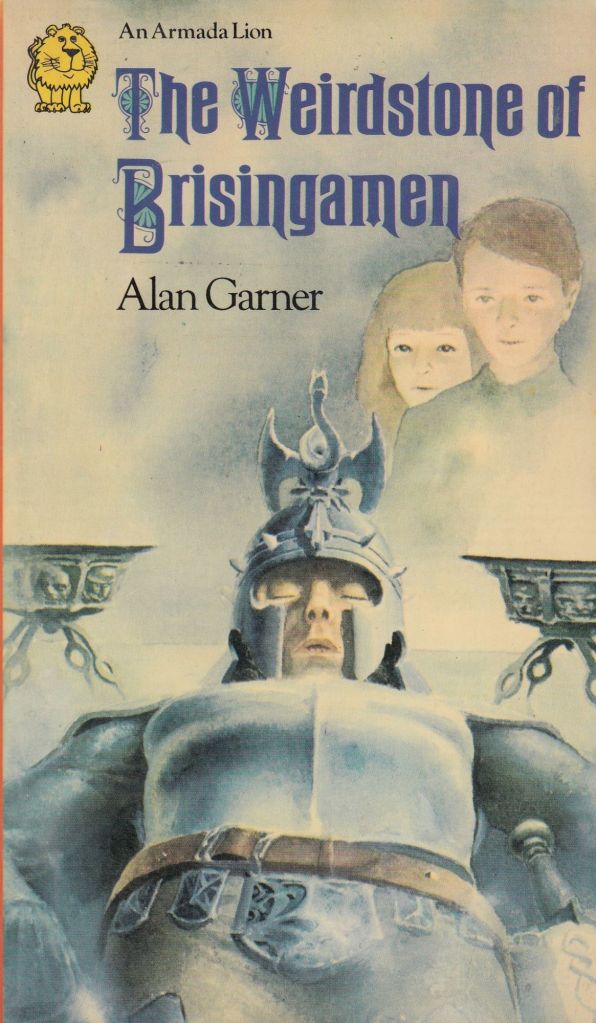
The Weirdstone

Why this journey and why ask you to accompany me? Well it would be easier to start with why Fantasy? Back in the day, when I was at lower school (that’s ages 5 – 9) I used to gorge on historical non-fiction from the school library and the scholastic book catalogue. Stories of Rome, Vikings and Crusaders entertained me on many an evening. My heroes at the time were, Caesar, Scipio, Leif Erikson and Richard Coeur de Lion. And then there were the weird ones. Books covering UFOs, mysteries, Loch Ness, myths and legends. Greek gods, Norse gods and Roman gods were my weekend reads. I am sure you can see where this was going. But at the time, I couldn’t – Not until my Form 6 teacher read Alan Garner’s ‘The weirdstone of Brisingamen’ to us.

Oh

my

word

…..

From the intro I was spellbound (did you see what I did there?). Cadelin Silverbrow keeping watch over the sleeping knights in Fundindelve, ready to waken and save the land. The characters were both fantastic and believable, as believable as my historical heroes. And the main protagonists; Colin and Susan, were just like me – well, Colin was, Susan was slightly different. I felt I was being sucked into the world that Garner had woven, just as Colin and Susan were drawn into the mystical battle between Cadellin and his allies and the forces of the Morrigon. It felt to me that Garner’s world could have been under any hill, in any wood or anywhere. But after a while I came to realise that it wasn’t that.  The world of Cadellin and Fundindelve, like so many others in the Fantasy genre, can be found at the turn of a page.

Since then countless other books took pride of place on my shelves – Howard, Burroughs, Leiber, Le Guin, Harrison, Tolkien, Eddings, Feist et al. All were fantastical worlds to be lost in, worlds to replace the humdrum of daily life. But all had the ability to be perceived as more realistic than a world where nurses are paid a pittance whilst sports and entertainment starts are paid millions, reality TV stars can be elected as presidents, and the world’s most powerful tool is used to watch videos of people falling over (which I will admit, can be quite funny).

As a footnote to The Weirdstone, some thirty odd years later, I named a character in an online RPG as Brisingamen in homage to the book. I met some fantastic people as Brisingamen, and after a few years I went to visit a great couple only to found myself driving past Alderley Edge a few miles outside their town of Macclesfield, the scene of the final cataclysmic battle in the book. It was as if the circle was complete.

Not really a circle – more an ouroboros.

Featured

The Elven Scroll . . .

A long time ago, in a land far, far away, I was introduced to a whole universe of magical worlds, the creation of countless authors and scribes throughout the years. After wasted years of pondering and procrastinating, I am aiming to join them.

Chained to my writing desk in my scriptorium, I am nearing the completion of my first work. My candles are burnt low and quill shavings pile upon the floor. But I want to chronicle my thoughts, ideas and works – mainly to inspire myself, but also hopefully – should you join me on my adventure – you also.

Here I will collect ideas; simple plots, pictures, articles and words that are just seeds and acorns now but, with a little nurturing, will turn into mighty beanstalks or oaks. Also, I will share my influences (past and present) along with the sagas that I am reading now – and will look forward to your recommendations.